Clariva is a free college-planning platform. It tells a student where they stand against 1,600 colleges using published admissions data, and never lets a language model invent the answer.
Some students have someone whose full-time job is answering where should I apply, and what do I actually need to do to get in. Most don't. Counselors know this better than anyone: they carry caseloads far above what's recommended and are asked to do this on top of everything else.
Meanwhile the answers already exist in public records: the U.S. College Scorecard, IPEDS, and every university's Common Data Set. They're just spread across thousands of documents in a form no sixteen-year-old can use.
I was guessing too. I built Clariva because I needed it, and I built it free: no paywall, no ads, no subscription, no data sold.
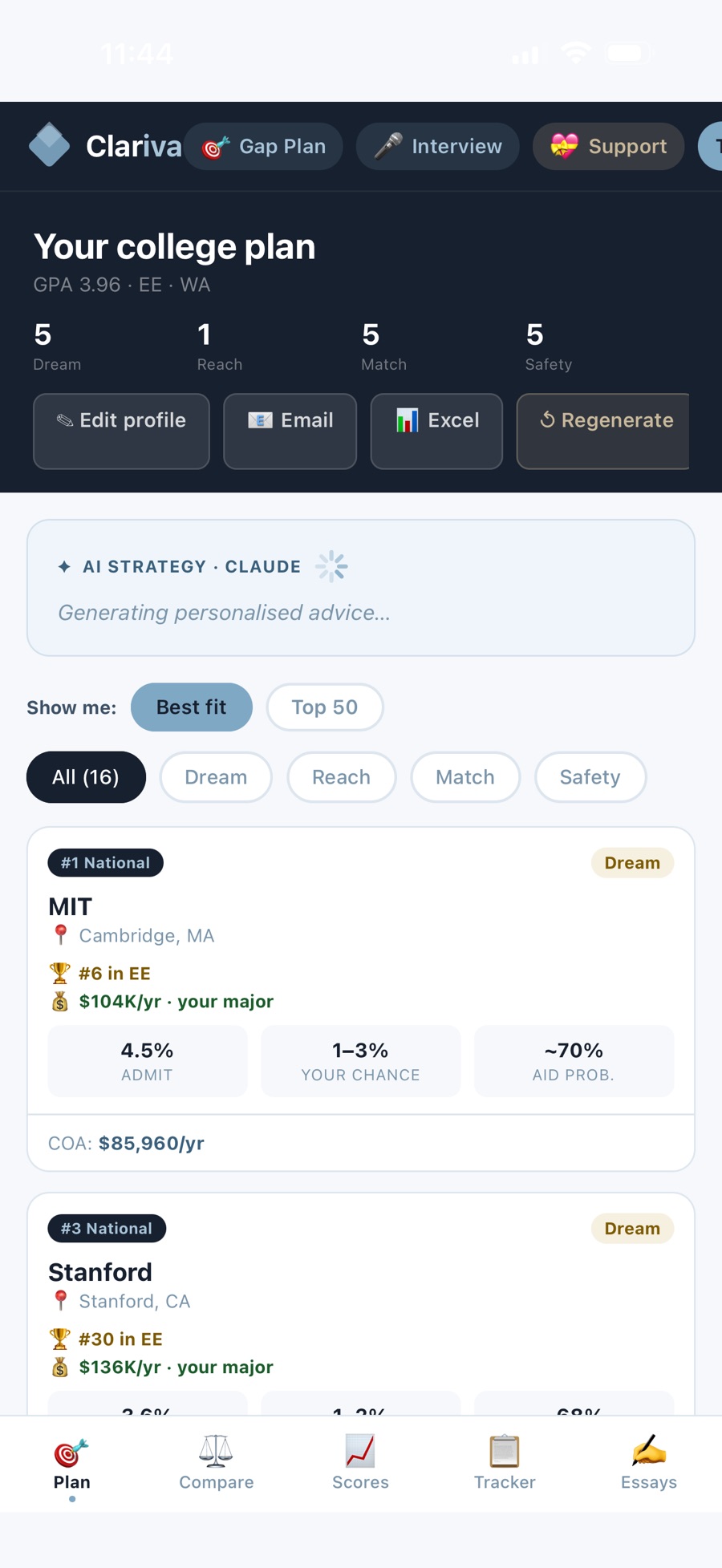
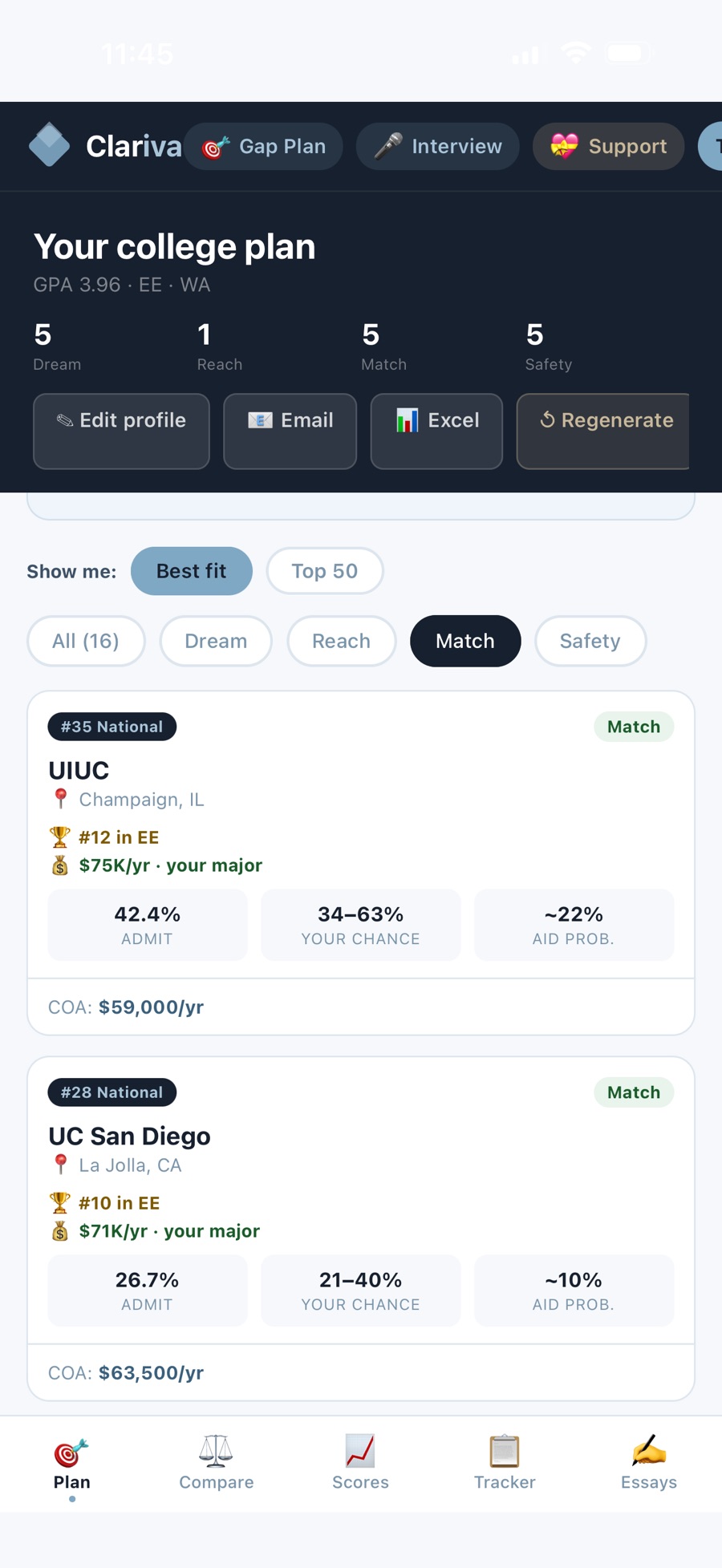
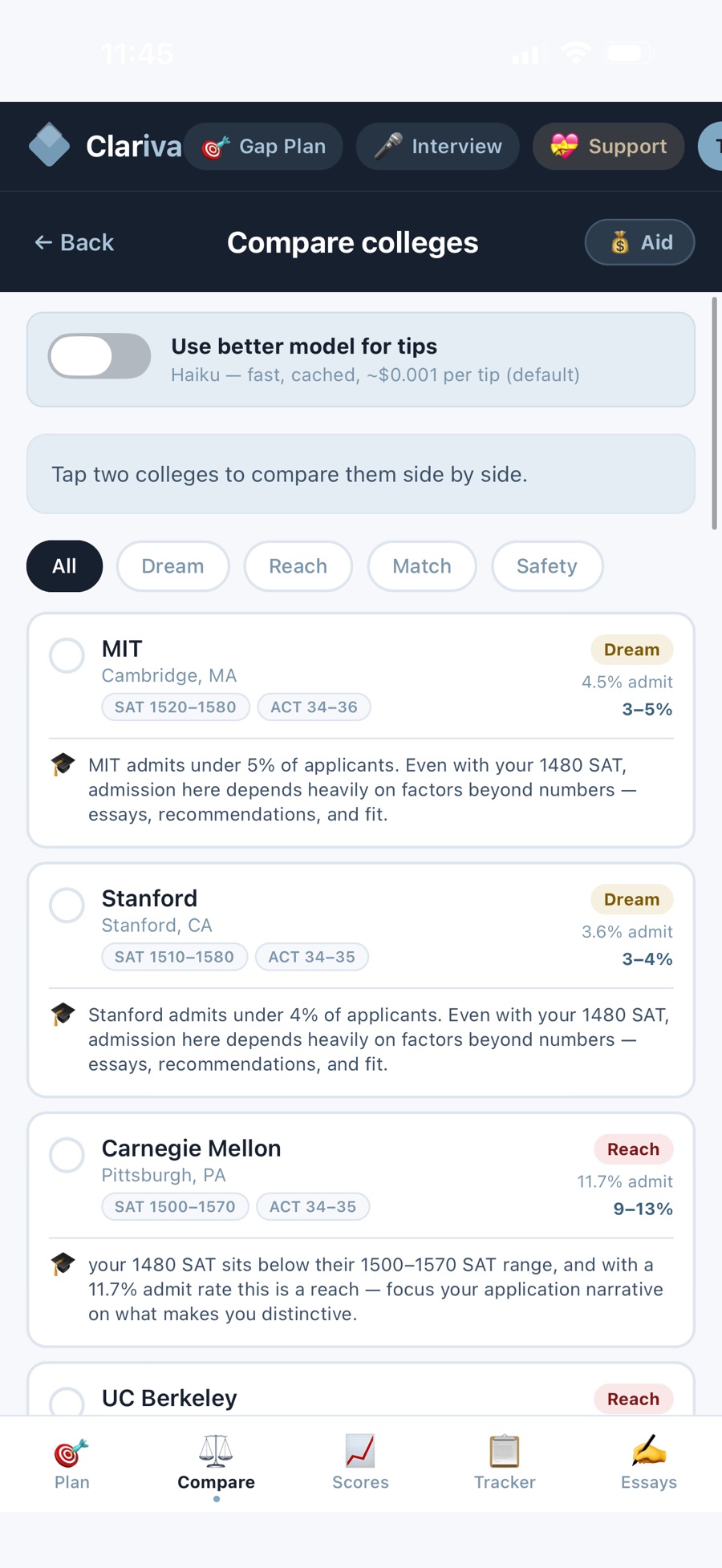
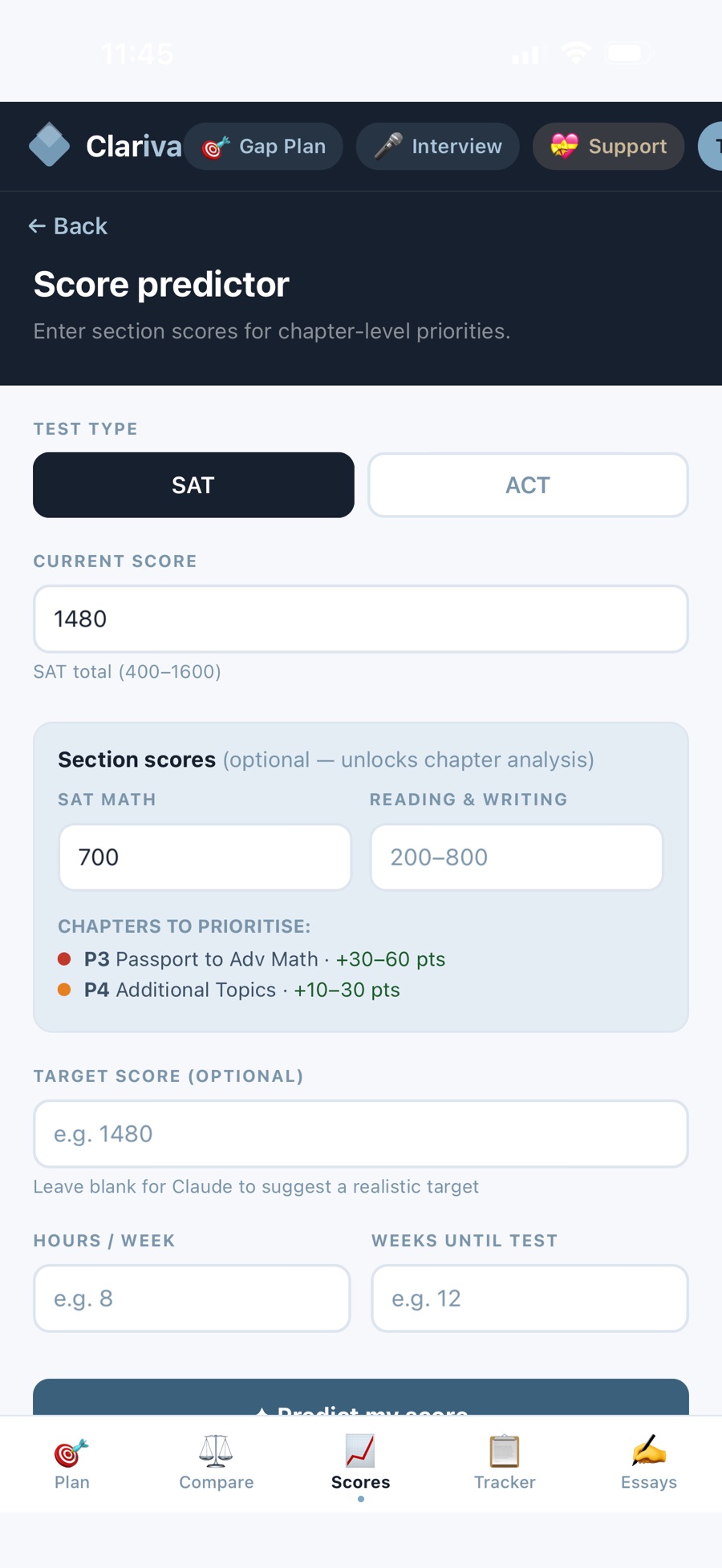
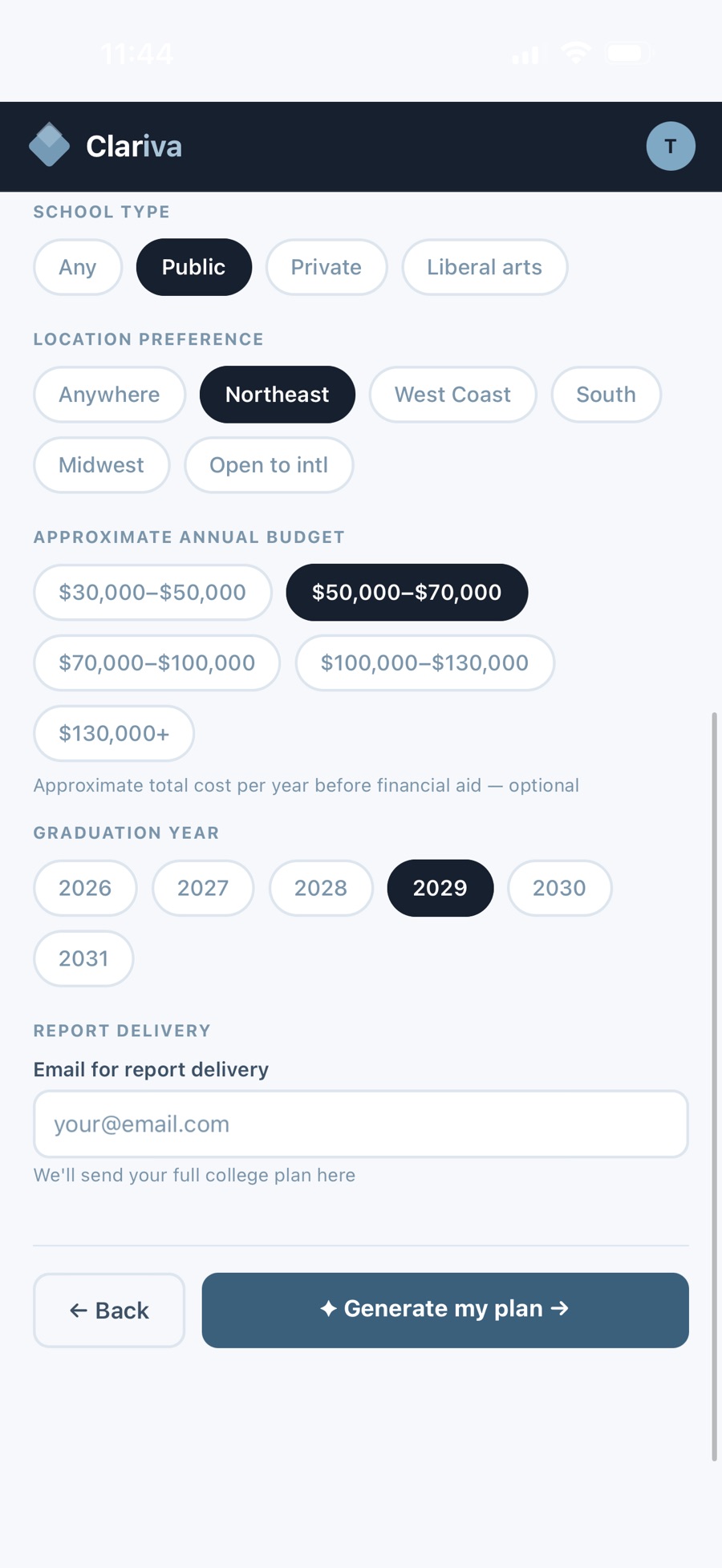
A plan built from the student’s own GPA and test scores, on the web and on iPhone, with every feature listed in the table below. Transcripts and activity lists can be uploaded and parsed, or typed in.
From the live iPhone app. Scroll for more.
| Feature | Problem it solves | Impact for a student |
|---|---|---|
| College list plan | Students without a counselor guess which schools are realistic for them. | A list across about 1,600 colleges, sorted into Dream, Reach, Match and Safety from the student’s own GPA and test scores. |
| Chances from a deterministic engine, not AI | AI chatbots give confident odds that nobody can check. | Every tier and chance is arithmetic on published figures, so the same profile gets the same answer on the web and on iPhone. |
| Early round strategy: ED, EA and REA | Early-round numbers sit in Common Data Sets that families rarely read. | For the 24 schools that publish them, the early admit rate, the regular rate and the share of the class filled early where reported, plus a warning before any binding Early Decision. |
| School and major research | A school’s facts are scattered, and a capped engineering program is harder to get into than the university. | One page per college with its published admit rate, score ranges and costs, plus a separate estimate for each major it reports and that program’s national rank. |
| Gap Plan | Students know their target schools but not what to change. | Concrete next steps from the student’s profile toward those targets, marked as AI-generated. |
| Score Predictor | Students don’t know which test sections to study first. | Section scores turned into the chapters to prioritise by fixed rules, plus an AI estimate of an achievable score, clamped to a realistic range. |
| Cost and aid | Sticker prices hide what a family would actually pay. | Each school’s federal net-price averages by income bracket, and scholarship matching that runs on the device; family income never leaves it. |
| Application tracker | With several applications at once, it is easy to lose track of what is done. | Each college’s status, from researching through essays and submission to the decision, with its deadlines and the student’s notes, plus weekly deadline reminders by push notification. |
| Senior-year timeline | Deadlines and aid dates are spread across many sites, and a missed FAFSA date can cost a family aid. | One calendar from August to May: Common App, FAFSA, CSS Profile, mid-year reports and May 1, merged with the ED, EA and RD deadlines of the student’s own colleges. Younger students get a roadmap for their grade. |
| Decide: compare award letters | Award letters count loans as “aid”, which makes an expensive offer look cheap. | Each admitted school’s offer side by side: true cost is cost of attendance minus grants only, loan-heavy offers are flagged, and the four-year total is shown. Nothing entered is saved. |
| Try it without an account | Students hesitate to sign up before they see any value. | A starter plan with no account; nothing is kept after the session. |
| Safety for minors | Most of the people using Clariva are under 18. | Crisis-language screening runs before every AI call, and parental consent for under-18s is recorded on the server. |
All live on the web and iPhone as of October 18, 2026. Impact describes what each feature does for a student, not measured outcomes.
Clariva's hardest engineering choice was refusing to let the AI decide a student's chances.
A deterministic classifier computes every admission estimate from observable Common Data Set quantities: the student's score against the admitted middle-50% band, unweighted GPA against the admitted-cohort anchor, and a per-major difficulty factor. In the admissions features, the language models only explain results they were handed, and are barred from asserting any statistic not already in the prompt.
An earlier version let an AI “fit” score nudge one factor by up to 25%. Clamped or not, that was a model deciding a number, so we removed it in September 2026: the AI’s view of fit now appears as text beside the estimate, and a test hands the engine an AI factor and checks that no tier moves.
Around 1,400 automated checks hold the invariants: GPA can move a school at most one tier and can never fabricate a safety school, the engine never invents one to fill an empty tier, and a parity suite asserts the independent web and iOS engines agree exactly.
Hand the student's profile to a language model and ask for their odds. Fluent, confident, and impossible for anyone, including me, to check.
Compute the odds in deterministic code from published data, then let the model explain the result. Every published figure traces back to federal data or the college’s own Common Data Set.
Published figures and estimates are different things. Admit rates, score ranges and costs are shown as the college or the federal government reports them. Tiers and chances are estimates: the engine’s arithmetic on those figures, not a measured prediction. Students can report their real admission results anonymously, and once about a hundred are in, after the spring decisions, each tier’s predicted range will be checked against what actually happened.
That changed the engineering, not just the terms of service. Content screening runs before every AI call and checks for crisis language first, so a student in distress gets a crisis-line response rather than a rejection notice.
Family income never leaves the device; aid eligibility is computed locally. Uploaded transcripts are parsed in memory and never stored. Parental consent for users under 18 is recorded server-side in an append-only record, and the approval fields are built so that self-approval is structurally impossible rather than merely disallowed.
Because the service is free, a hard daily spending ceiling, enforced by an atomic transaction that charges each call before it runs, bounds the worst case no matter the traffic. Free had to be a mechanism, not a promise.